Flintoff’s rejection of an England central contract is another triumph for private capital over national good. It was the England and Lancashire teams that nurtured his development into an international star worthy of private interest, yet as he’s auctioned-off around the world it's Andrew ‘Chubby’ Chandler who collects the rewards.
There is nothing new about mercenary cricket. After all, the sport developed with wealthy English patrons hiring freelance ‘professionals’ in the 1700s. Of course back then the game was also defined by gambling and match-fixing. But in today’s post-crisis age of austerity it is particularly galling to read Chandler gloating about the deals he is to make.
Yet concerns that freelance cricketers embody a final ‘globalisation’ of the sport remain unfounded.
Developing a gifted child into a world-class athlete is a lengthy and risky investment. Even now the ECB pays for Flintoff’s rehabilitation. National boards have to realise that they remain central to the developing world order. Young players must still learn in domestic cricket before getting the chance to play abroad. They should use this power to ensure a cut of the deals and protect the interests of the national team.
It’s time to regulate the agents and ensure successful cricketers return money to the people that made them instead.
Showing posts with label flintoff. Show all posts
Showing posts with label flintoff. Show all posts
Wednesday, 16 September 2009


Friday, 21 August 2009
The 'Golden Age' of batting exposed
 Day 2 - Close
In years to come, today’s play will form delirious memories and nostalgic ad campaigns.
Thirteen wickets fell in two sessions to leave England within touching distance of a glory that yesterday seemed to have eluded them.
The day shed light on the so-called ‘golden age of batting’. Never before have so many batsmen in the world averaged in the 50s, never have so many runs been scored so quickly and so often.
Yet today exposed how the flat pitches that dominate Test cricket are entrenched in the mental and technical make-up of batsmen. When confronted with a remotely sporting wicket, they folded instantly.
No batsman fell to a grubber, no ball leaped off a length; instead wickets were earned through a spell of quality seam bowling, lively spin bowling and some questionable decisions. It’s difficult to believe more defensively equipped players, like Rahul Dravid or Shiv Chanderpaul, would have crumbled in the same way.
If Test cricket is to really live up to its name, more fair pitches should be prepared. Scoring runs should be a challenge not a formality.
As Strauss and Katich showed, the gremlins today were more in the head than the pitch. Ashes pressure, so often England’s undoing, proved Australia's nemesis. But it was Stuart Broad, timing his coming of age to coincide with Flintoff’s retirement, that unleashed the doubts in Australian heads.
Australia's three wickets gives them a sliver of hope, but the series now is England's to lose.
Monday, 20 July 2009
Flintoff touches greatness
 Day 5 - Close
England win by 115 runs
In a contest between evenly matched teams, results can be determined by the briefest moments. The first hour this morning was one of those defining periods.
With England’s jitters and Clarke’s belief, you felt that between Australia and the history books stood only the new-ball spell from Andrew Flintoff. Having announced his retirement from an unfulfilled career, the pressure was on body and mind to demonstrate they could rise to these occasions.
Duly, they did. It’s only the great players who possess the ineffable ability to claim crucial moments as their own. Shane Warne, for instance, could turn entire series with the sheer strength of his personality. Today Flintoff touched that greatness once more as he bowled England to a one-nil lead.
It was a sight to cherish - the appalling state of Test pitches coupled with an unrelenting schedule threaten to kill off express-pace bowling altogether. Yet Flintoff, a high calibre casualty, produced one of the great hostile spells. Running on one-knee and buckets of adrenalin he took three wickets bowling unchanged for 13 searing overs. Again he dared to go full and again he was rewarded.
Few get the privilege of leaving top-level sport on a high, and Flintoff still has three games to go. But victory, the man-of-the-match and the Lord’s honours board is quite a way to launch the farewell.
Sunday, 19 July 2009
England and Australia close in on history
 Day 4 - Close
Momentum is a precarious category in sport. A seamless explanation for a run of play, it suddenly loses all relevance when that run of play changes.
England began the day with the momentum propelling their historic mission. Flintoff, in what may yet be his last Test for England, finally located the length that eluded his entire career. He pitched the ball up sufficiently to find, rather than pass, the edges of Katich and Hughes.
As Swann found a verve that Panesar couldn't last year to reduce Australia to 128 - 5, the 'momentum' was firmly with England. And then nothing. Michael Clarke's silky footwork and breezy confidence found a willing partner in Brad Haddin as Australia fought back. Gently and with growing certainty they dominated England. It was a measure of how flat England had become that Andrew Strauss felt compelled to call an emergency huddle before the second new ball.
England, haunted by Chennai, looked increasingly panicked as the second new ball failed to deliver the wicket. Such was their control, Clarke and Haddin would have been tempted to stay out there when shadows stopped play for the day.
With rested bowlers and 200 runs still in the bank, their lead is surely 'too big to fail', but we've thought that before. Modern pitches and Australia's unwavering belief make anything possible. England, though, will take heart that with just one wicket, the 'momentum' will suddenly be theirs again.
Wednesday, 15 July 2009
Freddie Departs...
 It seemed, as Flintoff creaked into his 35th over at Cardiff, that his captain was bowling him to an injury. Worse, Strauss succeeded in bowling Flintoff into early retirement.
Truth be told, this was on the horizon for a while. His fitness and form since 2005 has been a travesty. Time and again the cycle of injury, gloom, rehab and hope gripped the England side's perennial search for 'balance'.
It was Lawrence Booth, in his insightful weekly column, who first questioned the point of it all. Now journalists and punters alike readily cite the fact that England win more games without 'Fred' than with him. Statistics, though, are full of quirks. Flintoff struggled through the top sides - South Africa, India, Australia - but was left rehabilitating as others gorged on West Indies and New Zealand.
This however, cannot mask the fact that Flintoff only ever flirted with greatness. For three years under Michael Vaughan, culminating in that series he was possibly the most valuable cricketer on the planet. Since, he has failed to be the force on the field that he is off it.
While in an England shirt, Flintoff couldn't prevent forcing his body beyond endurance. He carried not only his colossal frame, but a toothless attack. Yet off the field, the riches from 2005 and frustrations of injury led to an increasingly public presence away from cricket. Perhaps the fire that drove him to the top was fading as he sought fortune and entertainment elsewhere.
The tragedy is that this series had appeared to light the embers once more. He was better prepared than any since 2005, was batting well and thundered in bowling faster than ever. Alas, his body duly resisted.
He deserves a vintage performance to close his Test career and could yet inject himself to fitness for the remainder of the series. Sadly public figures, sportsmen especially, rarely get the exit they desire. Whatever happens, Test cricket, shorn of Flintoff's brutal brilliance, will be a poorer sport.
Monday, 30 June 2008
A series for the quicks
 As England's one-day side folded all too familiarly I couldn't help but turn my attention to the upcoming Test series against South Africa.
 The merits of the shorter game, be it 20 or 50 overs have been trumpeted repeatedly recently. Test cricket though, especially between evenly matched teams presents a different kind of drama.
Without the restrictions on bowlers, field placing and overs for batmen, Test cricket leaves players naked. Every nuance of technique and character is explored. Hoping to triumph for the first time in England since 1965 Graeme Smith brings a buoyant South African side to Lord's next month.
Since re-admission South Africa have never quite managed to assert themselves on the world game. Branded chokers following habitual World Cup semi final losses they have never been a threatening force in Test cricket.
Cautious at best and outright boring at worst, their cricket was too often epitomised by Jacques Kallis. Despite his impressive statistics he has never had the belief to impose himself on oppositions and turn matches. It's a negative outset that for many years held back South African cricket.
But now united under a captain who demands respect without having to shout his mouth off, and free of the shackles of selection quota system, South Africa are playing vibrant cricket.
Dale Steyn has added dynamism to an attack that since Allan Donald's retirement has been little more than steady. How his skiddy pace adapts to English conditions could determine the outcome of the series. When a youthful Brett Lee arrived on these shores to a similar fanfare in 2001, he was taken apart by a hopeless England side.
England, following their hesitant triumph over the three-match series against New Zealand, are being brought nicely to the boil under Michael Vaughan. As always much depends on the fitness of Andrew Flintoff. If fit he lifts England's attack to another level backing up the likes of Ryan Sidebottom, Stuart Broad, Monty Panesar and Mr Mercurial James Anderson.
Abandoning reason and assuming Flintoff does return he magnifies England's biggest concern - their wobbly middle order. If they take the jump and play five bowlers, one of Paul Collingwood and Ian Bell would miss out, and Tim Ambrose's runs will be closely monitored. It places huge responsibility on the top four, but you feel the aggressive approach gives England their best chance and will make for a thrilling series between two strong bowling sides.
Given their recent form South Africa must start favourites, but if England's top order can conquer Steyn then the road for the Ashes may yet be paved with gold.
Wednesday, 6 December 2006
Horror
Second Test, Adelaide
Day 5 Comment
Day 5 Comment
To win Test matches, you need to make opportunities and grab them. Australia, for the majority of the time at Adelaide, had been outplayed. It was England who had the opportunities but failed to take them.
This test match has exposed two teams with two different approaches. Australia are hungry, motivated and desperate to win the Ashes back. England are desperate not to lose them. It's only a subtle difference of approach, but, when amplified by day-five pressure, it became a devastating rift that saw England become gutless with the bat and then hopeless with the ball.
It’s sad for England but cricket is a cruel sport. One bad session cost Andrew Flintoff's men this match, and with it the series. The credit, however, must go to Australia. Seeing an opportunity to scare England on the final day is one thing, but having the unwavering belief and skill to ram home a famous victory is quite another. Here was a team of champions, albeit flawed champions, intent on ending the series as Ashes victors.
England needed to score about 100 runs on the final day to be safe. In the dressing room, all the talk would have been of surviving the first hour and then pushing on from there. This is where it went awry for England; you do not just survive on a last-day pitch against Shane Warne. He can build up all the momentum and pressure that way. It took England six overs to get 10 runs in the morning, an approach that played into the super spinner's hands.
On paper it seemed painfully obvious – flat pitch, go out there, attack and we’ll write this game off. But the middle is a lonely place for a batsmen; a combination of 11 fielders, 30,000 spectators and the knowledge that one mistake ends your match creates a pressure that is unique to cricket.
The muddle in the batsmen's minds was made clear early on with Andrew Strauss wafting outside his off stump. The survival plan came to a tumbling, pointless end with a poor decision from umpire Steve Bucknor, giving the Middlesex man out caught. England had not progressed at all and Australia had a breakthrough. There was no recovery; Paul Collingwood was the only batsman to survive but he could not get the ball of the square and England drifted slowly and painfully towards disaster.
Warne, as he so often is, was the master, fizzing and spitting the ball past the batsmen. This, however, is only half of his skill; his presence and will got inside of the England psyche. He had them panicking and he knew it. There was no respite for the tourists, either, as Warne received great support from Brett Lee, Stuart Clark and Glenn McGrath who, seeing the opportunity, backed themselves and raised their games as champions do.
It left Australia needing 168 to win from 38 overs.
Whilst Australia got off to a flyer, they did lose early wickets. At 33-2 England had a chance of winning the match, but no one in their side believed they could. With Australia needing less than four an over, Flintoff set defensive fields, with men on the boundaries and singles available everywhere. Ricky Ponting and Mike Hussey, under no pressure, collected easy singles as England drifted towards defeat.
Ashley Giles, who has built a career on bowling negative dross outside leg stump, suddenly found himself incapable of doing that - bowling short and on the stumps for 10 pointless overs. His place in this side further betrays England’s defensive mindset, but with victories now essential, he surely he must be dropped. Flintoff toiled manfully but had no support and Australia were guided home for a famous victory.
It is heartbreaking for England fans, and for cricket fans in general. This was the most hyped-up Test series in history, and after two matches, it's over. No England side has ever come back from 2-0 down to take an Ashes series. We shall of course, stick by them, but they need a fundamental change in approach if they are to compete.
For all but one day of this series, they have seemed to lack belief. Their aggressive, attacking instincts have been frozen by what Michael Vaughan called ‘fear of failure’. It is only now that we see how strong Vaughan’s influence was on last year's series. The England management have not instilled a belief in their players and questions must be asked of Duncan Fletcher. His team selection has been wrong, but the errors betray a deeper lack of confidence that has manifested itself in England’s play.
It is hard for England, as they played with authority for half this match, even though Australia fully deserve their victory. Arjuna Ranatunga – the Sri Lankan World-Cup winning captain, wrote how cricket is a physical sport decided by strength of mind. Australia’s mindset has been one of complete confidence and aggression, and for that they have been rewarded with the match and with it, surely, the Ashes.
Saturday, 2 December 2006
Warne reduced to wides as Pietersen digs in
 Second Test, Adelaide
Day 2 Comment
It is not often that you’re able to compare Ashley Giles to Shane Warne but such was Pietersen’s complete technical dominance over his Hampshire team mate that Warne was reduced to bowling the negative, hopeless around-the-wicket line that made our very own King of Spain famous.
We must remember that this pitch is painfully slow and offers absolutely nothing to bowlers of any creed. Indeed New Zealand legend Martin Crowe once remarked on the three certainties of life - death, taxes and hundreds at the Adelaide Oval. But the nature of the hundreds scored by Collingwood and Pietersen was astounding. Whilst yesterday England seemed content on survival, today they took the game to the heart of Australian bowling – McGrath and Warne and left them battered, bruised and with one wicket for 274 between them. Their worst ever return.
McGrath in particular looked a spent figure, at Brisbane he was flattered by England’s woeful batting but on this pitch he never looked like taking a wicket and was treated with disdain by Pietersen who waltzed down the track to smack him through the leg-side on numerous occasions. As more question marks over McGrath’s fitness presented themselves, so did the perceived weakness of Ponting’s captaincy. Some of his ultra defensive field settings were shocking as England merrily collected runs under no pressure whatsoever.
Duncan Fletcher has remarked that Pietersen is one of the smartest cricketers he has ever come across. A quick interview with Kevin will illustrate that it is his cricketing brain that Fletcher is referring to but the way in which he dealt with the ‘Shane Giles’ negative approach was superb. For a player so exuberant and in such fluent form it was not easy to kick the ball away over after over but he kept his head and with the aid of some stunning footwork and balance was able to hit Warne against the spin through mid on, whenever Warne’s negative line erred slightly. It was his best test innings by a distance, and one of the best displays of tackling leg-spin that you will ever see.
Australia may have regretted playing four bowlers on the best batting wicket in the country, especially after the England bowlers could only muster up 9 wickets for 804 in Brisbane. But England, may well rue the similarly conservative selection of Ashley Giles. For them to take 20 wickets and win this match would be a remarkable effort, for greater then the brilliant batting display – and Panesar’s presence would have helped.
What followed was England’s best passage of play this series, giving themselves nine overs at the back end of the day to have a go at the Aussies. It is not easy coming out to bat after 168 overs in the field and England took full advantage. They were aggressive, lively and right up at Australia. Flintoff crucially took the new ball and got the reward of Justin Langer caught off a rising delivery. When at his best, our captain is one of world’s premier fast bowlers and if England are to square the series here in Adelaide, his performance will be the difference.
Monday, 27 November 2006
Seven steps to fight back in Adelaide
 First Test, Brisbane
Day 5 Comment
Australia reaffirmed their dominance by quickly dashing any hopes of a batting miracle this morning, leaving England with very little to take from this game into Friday’s crucial second test.
Now if this Ashes series is to really take off, England have to win in Adelaide. The result is even more significant than the first test. And England might find that the sense of occasion – though immense – will be less fraught then it was in Brisbane.
It’s a familiar situation for England and they know what needs to be done. The question is whether Flintoff can convince his men that they can do it; that they are capable of formulating a strategy that will press the Australians, and ultimately force a win in Adelaide.
As a guide to the psychological feeling England should be adopting here, let’s be introspective for a moment. I know how much I care about the England performance. I dream, analyse and despair over each ball in every test. So, look at yourself honestly. Do you believe England can come back?
I know I do, and here’s how.
1. Pick Panesar. It’s attractive to delude yourself into thinking that the mighty Monty would have made all the difference at Brisbane. He wouldn’t have. But he gives England control and an attacking option during those long Kookaburra 20-80 ‘middle’ overs. Anderson, though bowling well at times, was too inconsistent for a batting line-up of Australia’s stature. Monty should replace him at 11.
2. Win the toss. You could argue that one shouldn’t plan for things that are out of our control, but Harmy’s radar is beyond anyone’s control and yet we still plan around that.
3. Needless to say it, but bat, bat and bat. This means that Strauss will actually have to play himself in before trying to clear the world’s biggest boundaries with his almighty hook.
4. Open the bowling with Freddie. I have banged on about this for the last three days. Give your strongest bowlers the best possible chance with the new ball. It is for the same reasons that Australia prefers McGrath over Hussey with the new ball.
5. Think 2005 not 95. England are Ashes winners. They are a bunch of aggressive, gifted and tough players who thrive on playing attacking cricket. Through much of this test, England’s body language in the field was meek, lethargic and purposeless. On flat pitches, fielding sides have to work doubly hard to create pressure. This means disciplined fast bowling with occasional short balls that reach neck height, not regular waist-high long-hops.
6. Play on the opponent’s pressure. Australia had a 100-day countdown to this series. They have been subjected to boot camps and at Brisbane resorted to dispersing the Barmy Army around the ground and sending their trumpeter packing. They are obsessed. Their desire is feverish. Ponting almost threw a Trent Bridge-esque fit when dismissed for 196 and when Stuart Clark dropped Pietersen on the third day, he received withering glares and was ignored by his teammates. Australia has put themselves under huge pressure to reclaim the urn. If England could sustain a period of dominance and scare them; the Australian players, media and supporters have the potential to explode.
7. And finally, the elephant in the room, Stephen James Harmison. It is unfair of us to project our dreams on to him, but many have. He has to play at Adelaide, but must not become the distraction he did at Brisbane. If he’s not firing, use him as a middle over stock bowler. Set the field back and let him toil away for few runs. In Brisbane England wasted time and energy trying to get him right. Sky Sports spent more than two days demonstrating their split screen analysis of his bowling action. Every paper has put in their two-cents worth. It’s all a distraction. For now he should accept Dennis Lillee’s offer for a few coaching sessions. Lillee is the finest fast bowling coach in the world and a mentor to Troy Cooley, the coach who took England to Ashes success before switching sides. Now that nothing is expected of him, Harmison may roar in and win England the Second Test. But if he doesn´t, lets not spend five days talking about it.
The first test has been the worst of starts for England, yet they and the Aussies know that this series is far from over. Bring on round two.
Saturday, 25 November 2006
England shoot a gift horse in the head
 First Test, Brisbane
Day 3 Comment
These are dark days for England. Yesterday they made good bowling look great, and a dodgy pitch look a minefield. Predictably, they were skittled out for 157.
But what followed was less predictable, though far more damaging. Ricky Ponting as if he was somehow bemused by the lack of contest, threw England a lifeline. Not for the match, which was over, but for the series.
Before that what we desperately needed was an opportunity to regain ground in the mental war. We needed something positive to take into the rest of the series. Just as how despite being thrashed at Lords in 2005, England showed they could take learning into the rest of the series.
And Ponting threw down that gauntlet.
He gifted England an opportunity to run in and redeem their shoddy display of the first day. To prove to everyone that it is England who has the more potent fast bowling unit. Prove that day one was just nerves. Prove that they can come back strongly in this series, just as they did in the last.
It was an extraordinary piece of generosity. It looked like Buchanan and Ponting had conjured up one trick too many for this game – one that could come back to haunt them. They offered England a much-needed turning point in the series. Flintoff should have roused his men, urging them to fire, aim to take down five wickets for 100 and leave Ponting declaring again in the match, but this time limply and under a barrage of questions. It is not easy to lift yourself after such an abysmal batting display but Flintoff and England were given that chance.
Instead we were subjected to the worst display by an England side for years. Anderson was tossed the new ball as an uninterested and despondent England shrugged around the field with little purpose, almost waiting for Ponting to put them out of their misery. There was little noise from England, no fight; this was a side that showed remarkable disbelief in their ability to compete. Flintoff has to take some responsibility for this. His leadership credentials are based on his ability to inspire and instil belief in his players. He failed to do that, and failed to take charge with the new ball. Given the opportunity to begin the fight back now, instead of at Adelaide, England seemed curiously limp of any desire. For followers of England it was the most desperately disappointing passage of play, matching anything from the dark ages of the 1990’s.
It cannot be stressed enough that test matches, and Ashes cricket in particular, is a psychological game. It’s very rare in this game that you’re thrown a lifeline from the brink of defeat. If England can’t regain the desire to compete in this series, there’s a flight leaving from Brisbane tonight.
Friday, 24 November 2006
In the battle of minds, Flintoff holds the key
 First Test, Brisbane
Day 2 Comment
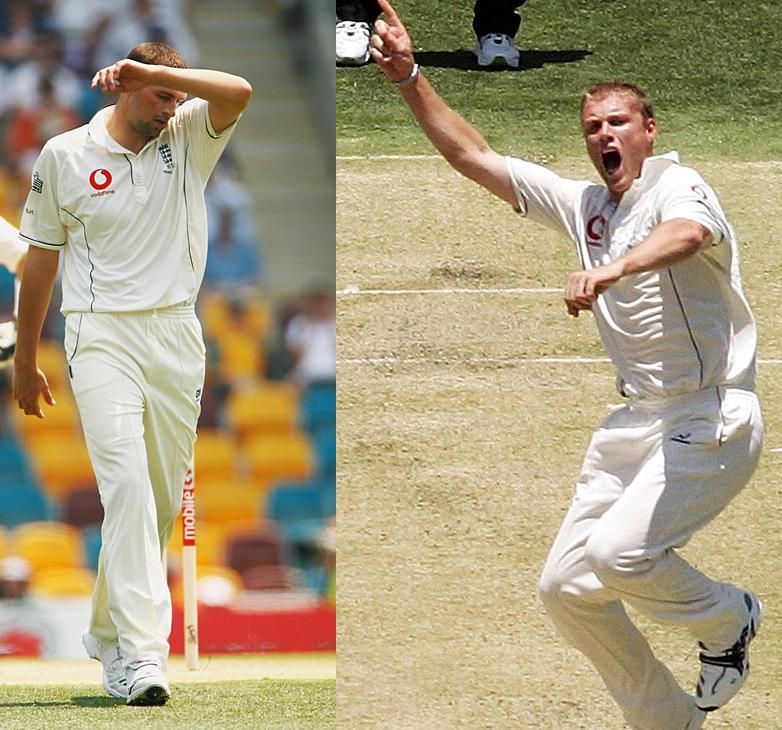
If you ever needed proof that much of test cricket is played in the head, look no further than England’s two strike bowlers. Flintoff and Harmison have all the potential to be world-beating quicks. Both have abilities to make a decisive impact on this series. But while Flintoff is revelling in carrying his side, Harmison is struggling with himself.
So much of Ashes cricket is about stamping authority on the opponents, thriving on the contest and dealing with confrontation. Harmison’s struggles are continued fuel for debate but it has been clear all tour that he is desperately low on confidence. Flintoff meanwhile is a different being. His strength of mind shows in the way he charged-in to Australia's batsman all day. Questions of confidence have never entered the equation. Yet Flintoff has bowled far less in the last six months than his Durham peer.
Looking back on this test match – which is all but decided now – many will cite that infamous first ball on Thursday. If the statement had to be made in that first over of the series, surely Flintoff was the man to do so. To play on a ground where Australia have always been dominant, and to take it upon himself to launch the Ashes would have been the best way for England - and Flintoff - to stamp authority on this series. Instead they opted for somone desperately short of match practise and vulnerable to gremlins when the chips are down.
It was a horrendous error of judgement that exposes the muddled thinking among England’s backroom staff. While we were driven to distraction about England's potential lower order batting woes, there has been failure to recognise that with so many bowlers coming back from injuries and lengthy layoffs, it is not the batting that needs propping up, it is the bowling.
What are these extra 30 runs that Giles is capable of providing down the order worth, when the opposition has amassed 602-9 declared? Giles toiled away admirably, bowling the dependable dross that has lent him a fantastic career. But what would Flintoff have given for the attacking and controlling presence of last summer’s highest wicket taker? Leaving Monty Panesar watching on helplessly from the dressing room, while Pietersen turned the ball is a decision that Fletcher will regret.
Hindsight is a curse for decision-makers, but a gift for commentators. Looking ahead, any chance for salvaging a result from this test ended yesterday evening when Strauss ended up pulling thoughtlessly down deep square leg. Now it it is essential for England to regain ground in the psychological battle. Bell must replicate the classy authority he showed this summer against Pakistan in the cauldron of Ashes pressure. Pietersen must show his resolve to stay at the crease long after Australia’s fiery spells of the opening session. Keeping the aging McGrath in the field for two days will do England’s chances no harm for next week’s second test.
England must prove to Australia – and perhaps themselves – that they are capable of taking this Ashes challenge head-on and coming out on top. If not for this test, than for the sake of the series.
Subscribe to:
Posts (Atom)

 Posts
Posts

